The Sunrise Chaser, My Story of Bromo, Ijen, and a Quiet Morning in Pinggan Village


The Moment I Got Lost on a Volcano
I remember the exact second I realized something was wrong. I was standing somewhere on the slopes of Ijen, it was still pitch dark, and I couldn't see my brother or his friends anywhere. Just fog, headlamps bobbing in the distance that weren't mine, and the smell of sulfur getting stronger with every breath. I had left a coffee break point a little too early, thinking I'd catch up with the group ahead. I didn't. For about thirty minutes, I just stood there and waited, trying to look calm, while my heart was doing anything but that.
When the fog thinned enough for me to actually see where I was standing, I realized I was right at the edge of the crater.
That thirty minutes taught me more about myself than most of my other travels combined. And it's part of why this story isn't really about two volcanoes and a sunrise point in Bali — it's about how I went from someone who had never hiked in her life to someone who now looks for excuses to do it again.
Why I Decided to Visit Bromo and Ijen

I'm not a hiker. I want to be upfront about that, because it matters for everything that comes after. I grew up in Malang, East Java, so Bromo was always somewhere in the background of my life — the mountain everyone talks about, the one on postcards, the place people from other cities fly in specifically to see.

Ijen, with its glowing blue fire, felt more like a myth than a real place I could visit. It seemed like something reserved for serious trekkers, not someone like me.
What pulled me in wasn't a bucket list or a hashtag. It was simpler than that. I wanted to know if I could actually do it — wake up at an unreasonable hour, ride in a jeep through the dark, walk uphill for hours in thin mountain air, and come out the other side having seen something worth all of it. Bromo and Ijen became less about scenery and more about proving something to myself.
Starting the Journey

The Bromo trip happened during Idul Fitri, when we flew back to Malang — my hometown — to celebrate with family. Since we were already there, going to Bromo felt like the obvious thing to do. We stayed at home in Malang, nothing fancy, no resort countdown or itinerary spreadsheet. Just family logistics and a plan to leave in the middle of the night.
The pick-up came around 1 to 2 AM. Two jeeps pulled up outside, engines rumbling in that specific way that tells you everyone else on the street is asleep except you. I remember that mix of excitement and disbelief — the kind where part of you is still asking "are we really doing this right now?" while you're already zipping up a jacket and climbing into the jeep. There's a particular kind of silence at that hour, broken only by engines and hushed voices, that I've come to associate completely with this trip.

Mount Bromo: Sea of Sand and a Sky on Fire


We arrived at the viewpoint around 4 AM, and the cold hit immediately — the kind of cold that gets into your fingers and makes you regret every joke you made about "just bringing a light jacket." The sky was still dark, but there was already a crowd gathering, headlamps and phone flashlights scattered across the viewpoint like fireflies. Nobody was loud. Everyone seemed to understand, without being told, that this was a moment you don't talk over.
Then the light started to change. Slowly at first — a thin line of orange at the horizon — and then all at once, the whole sky opening up in colors I genuinely don't have accurate words for. Soft pinks bleeding into gold, the silhouettes of Bromo and the surrounding
peaks slowly becoming visible out of the blue-black dark. I remember just standing there, cold hands wrapped around a cup of something warm, not really talking, just watching.

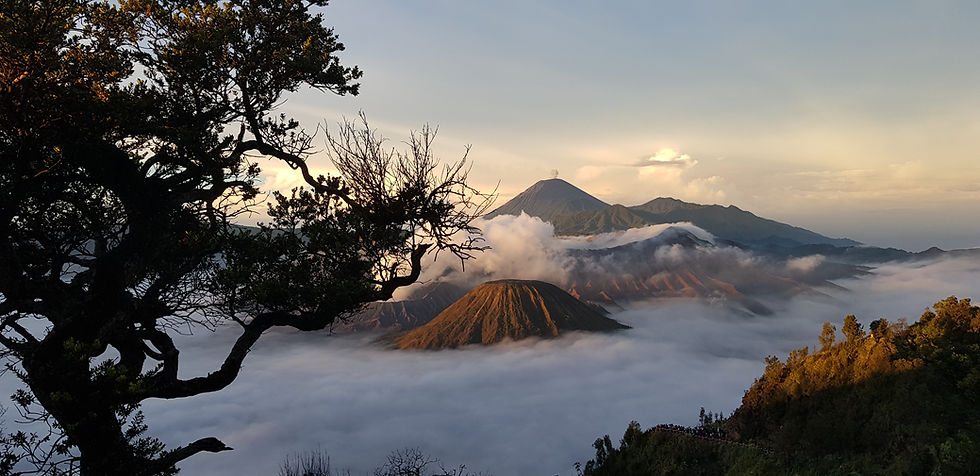
After sunrise, we made our way down into the Sea of Sand, that wide, pale, otherworldly stretch of volcanic terrain that looks like nowhere else I'd ever been. No hiking was required to get close to the crater area itself — the jeep did most of the heavy lifting, which honestly made this leg of the trip feel more like a scenic adventure than a physical one. What stayed with me most was the sky afterward — once the sunrise colors faded, the sky turned into this impossibly clear, deep blue, with Bromo's crater smoking gently in the middle of it all. We spent a good stretch of time just capturing that — the landscape first, then that clean blue sky that felt like a reward for waking up so absurdly early.
The people we met along the way were part of what made Bromo feel special. Many of the local guides and jeep drivers we spoke with were from the Tengger people, an ethnic Javanese sub-group who live across the highlands surrounding the Bromo-Tengger-Semeru mountains. Most practice a distinct form of Hinduism that doesn't follow a caste system and blends with older ancestral beliefs — something you can sense in the quiet respect people have for the mountain itself, not just as a tourist attraction but as something sacred.
Bromo, in the end, didn't ask much of me physically. No hiking, no exhaustion, no sore legs. It gave me the spectacle without the struggle — which, looking back, made it the perfect warm-up for what Ijen would demand later.
From Bromo to Ijen: A Different Kind of Journey

Our route back from Bromo took us to Malang rather than directly onward to Ijen — the two mountains ended up being separate trips rather than one continuous itinerary, and honestly, that gap in time gave me space to actually think about whether I wanted to attempt Ijen at all. Bromo had been beautiful, but it hadn't tested me. Ijen, I already knew, would be different. It required real hiking — something in the range of three hours uphill — and that thought alone sat with me for a while before I finally committed.

The Ijen Adventure: Blue Fire, Sulfur, and Getting Lost
I went to Ijen twice — first on February 2020, and again on July 2021. The first visit was, without exaggeration, a personal milestone. I had never hiked in my life before that morning. Not a short trail, not a warm-up hill — nothing. So agreeing to climb Ijen with my brother and his friends, all of whom had done it before, came with a very specific kind of nervousness. Everyone else knew what to expect. I didn't.
The hike itself was around three hours, mostly in darkness, mostly uphill. I remember the sulfur smell announcing itself long before we reached the crater — sharp, mineral, impossible to ignore. Headlamps cutting through the dark, the sound of boots on volcanic gravel, occasional stops to catch my breath and wonder, quietly, whether I was actually going to make it.

And then came the moment I mentioned earlier — the one that still sits with me. After one of the coffee break points, I left a little early, assuming I'd naturally catch up with the group ahead. I didn't account for how crowded the trail would get, or how disorienting it is when you can't see more than a few feet in front of you because of the sheer number of people and the low visibility near the crater. I lost sight of my brother and his friends completely. For about thirty minutes, I just stood still and waited, telling myself this was fine, this was normal, everyone gets separated on a hike like this. It wasn't until things cleared up a bit that I realized where I'd actually been standing — right at the edge of the mountain.

I'm not going to pretend that moment wasn't frightening. It was. But it's also the moment that, in hindsight, hooked me. Once I made it through — once I saw the blue fire flickering against the dark rock from the top, and later watched the crater lake turn a surreal turquoise in the morning light — something shifted. I had done something I didn't think I was capable of. That first visit ended up being less about the volcano and more about discovering I could push through fear and keep going. It's exactly why I went back a second time in 2021, on purpose this time, already knowing what I was signing up for.
At Ijen, the people working the mountain left as much of an impression as the landscape itself. Many of the miners and porters carrying sulfur down the crater are from the Osing people, the indigenous ethnic group of Banyuwangi Regency, where most of the Ijen area sits. Alongside them, we met porters and miners from Madurese and Javanese backgrounds too, which makes sense given how close Ijen sits to the border of Bondowoso Regency. Watching them carry loads of sulfur down the same steep trail that had already exhausted me — casually, in sandals, without headlamps half the time — put my own effort into perspective pretty quickly.
A Quiet Stop After the Climb: Jagir Waterfall
One thing I almost forgot to mention, and honestly one of the most underrated parts of the whole Ijen experience, was the stop we made afterward at Jagir Waterfall. After hours of sulfur, heat, and adrenaline, walking into that valley felt like stepping into a completely different world. The waterfall drops from a high cliff into a cool, shaded pocket of forest, and the whole area is covered in moss-covered rocks and greenery that make the air noticeably cooler than anywhere else nearby. After the intensity of the crater, standing there — damp air, the sound of water instead of my own breathing, no sulfur smell — felt like an actual reset button. If you're already making the trip to Ijen, I'd genuinely recommend building in time for Jagir afterward. It's not flashy, but it's the kind of place that lets the whole experience settle before you head back to reality.
Sunrise at Pinggan Village, Kintamani, Bali

The Pinggan Village sunrise happened on a completely different kind of morning, in a completely different place — Kintamani, Bali, rather than East Java — but it belongs in this story because it's part of the same habit Ijen gave me: waking up in the dark, chasing a view that only exists for a few fleeting minutes.
We started around 4:30 AM, still dark, still cold in that particular pre-dawn way. Unlike Ijen, there was no hiking involved here — just a drive from the village along a winding road full of ups and downs, taking somewhere between 30 to 40 minutes to reach the sunrise point. There's something almost meditative about driving through total darkness on a road you can't fully see, trusting that the driver knows the turns, watching the shapes of hills slowly emerge as the sky starts to lighten.
When the sunrise finally broke over the landscape, it was a completely different mood from both Bromo and Ijen — softer, quieter, without the adrenaline of a hike behind it. Just a calm, unhurried view that reminded me sunrise-chasing doesn't always have to come with exhaustion attached. Sometimes it's just about showing up.
The Moment I Will Never Forget
If I had to pick one memory that defines this whole journey, it's still those thirty minutes on Ijen, standing near the edge with no idea exactly how close I was, waiting for my brother's group to reappear out of the fog. It wasn't the blue fire, and it wasn't even the crater lake at sunrise — it was that stretch of uncertainty, and the fact that I didn't panic, didn't turn back, and kept going once I found my way. That's the part of the trip I keep coming back to when I think about why I went a second time.
What Was Difficult
I want to be honest here, because I think trip stories are more useful when they don't skip the hard parts.
Bromo was gentle on the body — no hiking required, mostly a jeep-based experience, so the biggest challenge was really just the early wake-up call and the cold. Ijen was a different story entirely. The three-hour hike, done mostly in darkness, tested me physically and mentally in a way I wasn't prepared for the first time around. The sulfur smell can be genuinely uncomfortable if you're not used to it. The crowds near the crater made visibility and movement harder than I expected, which was directly connected to how I ended up separated from my group. And there's the simple, unavoidable exhaustion of functioning on almost no sleep, hiking uphill, and still needing to stay alert.
None of it was unmanageable, but I'd be lying if I said it was easy.
What This Journey Taught Me
Somewhere between the sea of sand at Bromo, the edge of the crater at Ijen, and the quiet hills of Pinggan Village, I became someone slightly different than who I was before. Not dramatically — I didn't come home a changed person overnight — but I did come home a little more willing to try things I'm not naturally good at. Hiking still isn't something that comes easily to me. But now it's something I choose, rather than something I avoid.
Mostly, I just feel grateful. Grateful that I've had the chance to see all of this in my lifetime, and grateful that nature keeps giving me reasons to wake up absurdly early and go looking for it again.
Practical Travel Guide: Bromo, Ijen, and Pinggan Village Kintamani
Everything in this section is general travel information, separate from my personal story above. Some details — especially fees, permits, and access rules — change over time, so please verify current information with official sources or a local operator before you travel.
Best Time to Visit
The dry season, roughly April to October, generally offers the clearest skies and best sunrise visibility at both Bromo and Ijen. July to September tends to be the coolest and driest stretch, though also the most crowded.
How to Get to Mount Bromo
Most travelers reach Bromo via Malang or Surabaya. From either city, it's common to arrange a jeep tour through a local operator, who typically handles pickup from your hotel in the early hours of the morning. Some travelers also access Bromo from Probolinggo, which is closer to the Cemoro Lawang entrance.
How to Get to Ijen Crater
Ijen is most commonly accessed from Banyuwangi, with Bondowoso as another possible starting point. The hike to the crater rim typically takes around 2–3 hours, usually starting between midnight and 2 AM to reach the top in time for the blue fire phenomenon (visible only in the dark) and sunrise.
Recommended Number of Days
A common itinerary combines Bromo and Ijen over 2–3 days, often including an overnight stop between the two to manage the long travel and trekking hours. Adding Jagir Waterfall as a post-Ijen stop is a nice way to extend a trip by half a day without much extra effort.
What to Bring
Headlamp or reliable flashlight for both Bromo's early jeep ride and Ijen's night hike
Warm layers — temperatures near both craters can drop close to freezing before sunrise
A face mask or buff for Ijen's sulfur fumes (some tour operators provide gas masks)
Comfortable, broken-in hiking shoes for Ijen
A power bank, since cold weather drains phone batteries quickly
Clothing
Layering is key — a base layer, a warm mid-layer, and a windproof outer layer work well for both locations. Gloves and a hat are worth packing for Bromo and Ijen's pre-dawn cold.
Physical Preparation
Bromo requires minimal physical exertion, since most of the sightseeing is jeep-based. Ijen, however, involves a genuine multi-hour uphill hike on uneven volcanic terrain, so some basic cardiovascular fitness and comfortable walking pace will make the experience considerably more manageable, especially for first-time hikers.
Approximate Costs
Costs vary by season, group size, and operator, and entrance fees are subject to change. As a rough guide, expect to budget for jeep hire at Bromo (usually shared among a group), an entrance fee at both Bromo and Ijen national park areas, and optional gas mask rental at Ijen. These figures should be verified closer to your travel date, as entrance fees and regulations at both parks are updated periodically.
Safety Considerations
Ijen's sulfur gas can be genuinely irritating to eyes and lungs; a proper mask is strongly recommended, especially if the wind shifts fumes toward the trail.
Stick close to your hiking group near the crater rim, particularly in low-visibility, crowded conditions — as my own experience shows, it's easier than you'd think to get separated.
Check current access rules before your trip, as both Bromo and Ijen occasionally adjust visitor quotas, opening hours, or closed sections due to volcanic activity or conservation efforts.
Important Things First-Time Visitors Should Know
Sunrise viewpoints at Bromo get crowded quickly; arriving early secures a better spot.
Ijen's blue fire is only visible in complete darkness, so timing your hike is essential if that's a priority for you.
Local communities around both mountains, including the Tengger people at Bromo and Osing people at Ijen, hold cultural and spiritual connections to these sites — visiting respectfully matters.
Final Thoughts
Looking back, this journey was never really about ticking off famous viewpoints. It was about a version of me who had never hiked deciding to try anyway, getting a little lost along the way, and finding out she could handle it. Bromo gave me the spectacle, Ijen gave me the challenge, Jagir gave me the quiet after the storm, and Pinggan Village reminded me that sunrise-chasing can be gentle too. If you're on the fence about doing this trip yourself — even if, like me, you've never considered yourself an outdoorsy person — I'd say go. East Java and the volcanic landscapes of Indonesia have a way of teaching you things about yourself that you didn't know you needed to learn.
FAQ
1. Is hiking required to see Mount Bromo's sunrise? No. Most of the Bromo sunrise and Sea of Sand experience can be done via jeep, with only short walking sections, making it accessible even for those without hiking experience.
2. How long does the Ijen Crater hike take? Roughly 2–3 hours to reach the crater rim, typically starting in the middle of the night to catch both the blue fire phenomenon and sunrise. Exact times vary by fitness level and trail conditions.
3. Can beginners hike Ijen Crater? Yes, though it's a genuine physical challenge for first-timers. The trail is uphill and can take longer than expected, so pacing yourself and staying with your group is important.
4. What is the blue fire at Ijen, and when can I see it? The blue fire is a natural phenomenon caused by burning sulfuric gases, visible only in complete darkness, generally in the very early morning hours before sunrise.
5. Is Jagir Waterfall worth visiting after Ijen? Based on personal experience, yes — it's a peaceful, cool contrast to the heat and intensity of the crater hike, with mossy rocks and a shaded valley that make for a relaxing stop before heading back.
6. How far is Pinggan Village's sunrise point from the village itself? Around 30–40 minutes by car, along a winding road with ups and downs, so it's accessible without any hiking involved.
7. Can I visit Bromo and Ijen in one trip? Yes, many travelers combine both in a 2–3 day itinerary, though the exact routing and rest time between the two should account for the physical demands of Ijen's hike.
Note: Entrance fees, permit requirements, and access regulations at Bromo and Ijen are subject to periodic changes. Please verify current details through official park authorities or a licensed local tour operator before finalizing your trip.


Comments